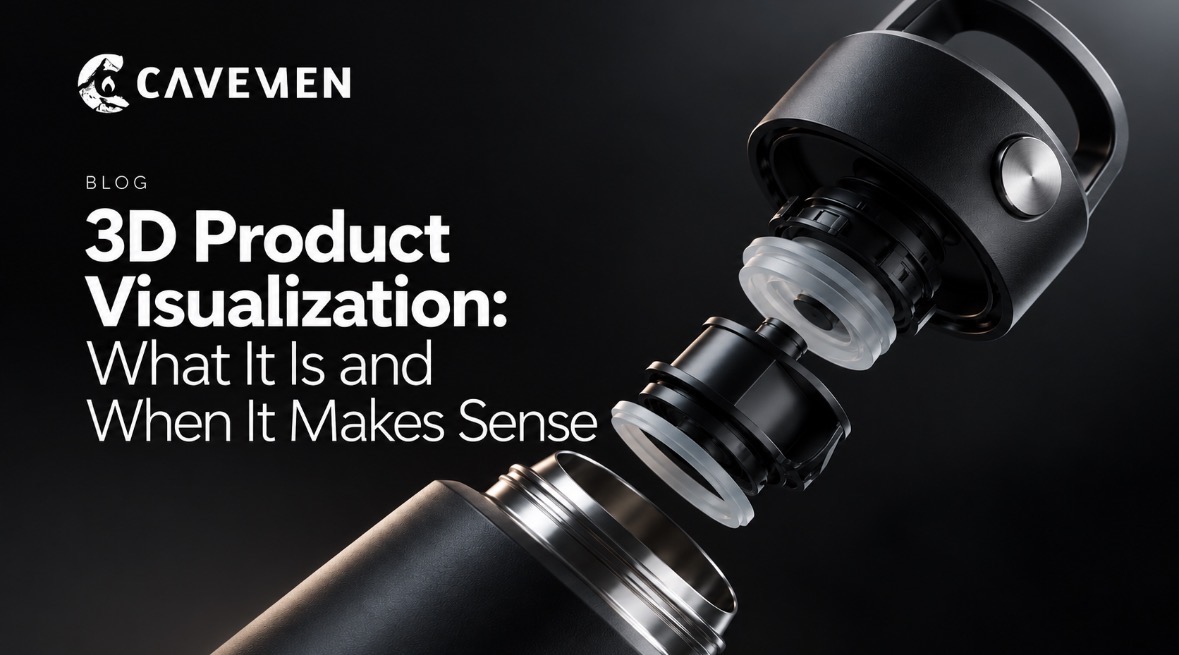
A product that does not exist yet. A line with many colorways. A mechanism that needs to be shown from the inside.
In cases like these, 3D product rendering gives you a digital version of the product and control over shape, materials, lighting, camera and environment.
The value of 3D is not simply making something look photographic. It is producing visuals a physical shoot may not be able to create efficiently.
01 / WHAT IT IS
What is 3D product rendering?
A product render is an image created from a three-dimensional model. Geometry is built or imported, then materials, textures, lighting and cameras are developed before the final image or sequence is rendered.
3D product rendering and 3D product visualization are closely related, but not identical. The render is the final output; visualization is the broader process and digital asset that can support multiple views, variants and animations.
It is also different from generating a product image with AI. In a 3D workflow, geometry and proportions can be built from measurements, drawings, photography or CAD, which makes it easier to keep the same product consistent across different assets.
Product renders
Images for ecommerce, catalogs, decks and advertising.
Animation
Motion that explains features, assembly or materials.
Variations
Color, finish and configuration changes from one approved base.
Technical views
Exploded views, cutaways and interiors that are difficult to shoot.
02 / WHEN IT MAKES SENSE
When does 3D make sense for a product?
Not every product needs it. If the item exists, is easy to access and a physical shoot solves the communication problem well, photography may be the most direct route.
3D becomes more useful when:
- The product is still in development.
- There are many colors, materials or finishes.
- You need to reveal internal parts, assemblies or mechanisms.
- You want consistent framing across a product family.
- One digital base needs to support stills, motion and multiple formats.
- You need marketing assets before a final physical unit is ready.
Once the model is approved, it can become a small content library: clean product images, close-ups, variants, campaign visuals, motion and new aspect ratios.
03 / 3D VS PHOTOGRAPHY
3D rendering or product photography?
They solve different problems, and they can also work together.
Photography usually makes sense when…
- The product already exists.
- There are only a few versions.
- Real people or locations are central to the campaign.
- Physical material variation is easy to capture.
3D usually makes sense when…
- The product is not ready yet.
- There are many variants.
- You need technical or impossible views.
- The same digital asset will be reused many times.
Is 3D cheaper?
Sometimes. A relatively simple product with many variants can benefit from a reusable 3D asset. A very complex product that only needs one final image may require more modeling work than a conventional shoot would justify.
04 / THE PROCESS
How a 3D product render is produced
01BriefWe define the product, the message and where the final assets will be used.
02ReferencesWe review CAD, drawings, measurements, photography, samples and finishes.
03ModelThe required geometry is built, adapted or cleaned for production.
04MaterialsColor, texture, reflection, transparency and roughness are developed.
05Light & cameraWe decide how the product should be presented, much like a controlled studio setup.
06Render & postImages are generated and refined through color, compositing and finishing.
At Cavemen, 3D animation, post-production and video production can live inside the same workflow, so the same product can move from still rendering to animation or live-action integration.
SELECTED WORK
Product and industrial visualization in practice
These are examples from our audiovisual portfolio. Scope and deliverables for a still-render project are agreed separately.
Wacaco Minipresso
A product-focused audiovisual piece from our portfolio. It illustrates product presentation, rather than a commissioned set of still renders.
Rehrig Pacific LATAM
3D animation showing reusable plastic products in a logistics and material-handling context.
For mechanisms, product demonstrations in motion and manufacturing processes, explore industrial 2D/3D animation.
05 / TO QUOTE
What information helps us quote a 3D product project?
ILLUSTRATIVE SCOPE
One model, nine images
A sample catalog brief, not a quote or actual client project.
One approved model
Three approved materials or colors
Front, three-quarter and detail
9 final images: one model × three finishes × three views. New geometry, separate campaign scenes, animation, alternate crops or source file delivery may require additional scope.
- Reference photos from several angles.
- Dimensions, drawings or CAD files if available.
- Material and finish references.
- Required product variants.
- Final use: ecommerce, campaign, social, presentation or video.
- Formats, resolution and deadline.
You can start with photos, sketches, measurements or CAD files. We will confirm how accurately the product needs to be modeled and which images, variants or animations you need.
To quote, we also consider the condition of the input model, number of products, geometry changes, surface complexity, final views, formats, review rounds and deadline. We can agree file formats, usage rights and source file delivery in the proposal. Technical references are validated by your team; confidential CAD files are not needed for the initial inquiry.
We produce 3D content from Mexico for local and international teams.
06 / FAQ
Frequently asked questions
Do I need a CAD file?
Not always. A product can also be modeled from dimensions, photography, drawings or other reliable references.
Can a 3D render look like a real photograph?
Yes, when the model, materials, lighting and finishing are built for photorealism. Not every project needs absolute realism, though.
Can the same model be used for animation?
Often, although motion may require extra preparation for parts, mechanisms or geometry.
Can Cavemen produce 3D remotely?
Yes. We work from Mexico with clients and creative teams in other markets, and most 3D production can be handled remotely when references, technical files and approvals are available digitally.
What affects the price of a 3D product render?
Modeling complexity, input files, number of products and variants, views, resolution, finishing and revisions. We quote the agreed scope.
Can you match our actual finishes and colors?
We use approved swatches, technical references and samples when available. Final color appearance also depends on lighting, display and print conditions.
Do we receive the editable 3D model?
Not automatically. Final images and the editable source model are distinct deliverables; source files, licensing and usage rights can be specified in the proposal.
Do not start by asking whether you need “a render.” Start by asking what the customer needs to understand about the product.
Choosing photography, 3D or both depends on the product, the required variations and where the content will be used. Each image should make the product easier to understand and present.